


#greengridz desks and tables put SDG 12 into practice by using fewer materials in production
August 28, 2025


For Marc van der Heijden, waste isn’t the end of a product’s life—it’s the beginning of a new design story. As the founder of the Dutch company TRIBOO, van der Heijden is on a mission to prove that circularity isn’t just a theoretical concept. It’s a scalable, design-driven business model that’s already transforming workplaces across Europe and beyond.
.webp)
.webp)
3D-printed NeverEnding furniture made from local waste streams of natural fibers and plastics. Office desks and tables equipped with innovative #greengridz countertops made with 60 to 90% less material and a 60% lower carbon footprint. EverUse acoustic panels made from recycled old clothing. And products returning to your office made from your own waste.
His approach combines material innovation with systemic change. The result? A growing portfolio of projects that are as inspiring as they are instructive for architects, interior designers, and product developers seeking sustainable alternatives.
At the heart of TRIBOO’s operations is a decentralized production model powered by digital workflows and local manufacturing. Furniture components are designed parametrically and 3D-printed using locally sourced waste streams from natural fibers and plastics, reducing transportation emissions and enabling just-in-time, location-specific production.
One of TRIBOO’s most notable achievements to date is the fully circular furnishing of Movares Group’s offices—an engineering consultancy with 12 branches across the Netherlands. A unique circular furniture subscription model serves as the financial framework for the entire inventory. More than 1,000 desks, cabinets, and meeting tables were manufactured using 15,000 kilograms less material and with a 60% lower carbon footprint. 750 kilograms of old military clothing were recycled and used as fabric in the acoustic desk dividers. The project also included 3D-printed tables made from 100% recycled materials, modular soft seating, and furniture crafted from reclaimed wood. For Movares, the decision was about more than just sustainability—it was a practical and scalable solution that aligned with their engineering ethos.
This project exemplifies van der Heijden’s belief that design and logistics must go hand in hand to achieve true circularity. “If we want to keep materials in the loop, we need to rethink the entire production system—not just the material itself,” he said in a recent interview.
.webp)
One of van der Heijden’s key innovations is #greengridz—a lightweight, durable, and fully circular sheet material used for the production of countertops and furniture. The goal is to replace all traditional solid furniture panels in the European market and beyond with #greengridz within 10 years. By reducing material use, less recycling is needed, and the waste problem becomes smaller and smaller.
By closing the material loop for these surfaces—which are often considered low-value and difficult to recycle—TRIBOO has demonstrated the commercial potential of true end-of-life recovery.
The Greengridz platform also gives designers greater creative flexibility. The panels can be CNC-milled and combined with 3D-printed elements, enabling hybrid structures that are both functional and expressive. For architects and interior designers, this introduces a new design language—one that is digital, modular, and circular by default.
.webp)
Van der Heijden doesn’t just challenge the way furniture is made—he challenges the way it’s owned. TRIBOO’s Furniture-as-a-Service model allows clients to lease products for a fixed period, after which they can be returned, refurbished, or recycled.
This approach ensures that materials remain within TRIBOO’s circular ecosystem, reducing waste and encouraging more responsible use. For clients, it offers flexibility and transparency: predictable costs, a lower environmental impact, and a clear materials passport for each item.
The company has implemented this model for several corporate clients and public sector organizations, including city governments and real estate developers seeking long-term, adaptive furnishing solutions. It also aligns with emerging procurement frameworks in the EU that prioritize circular tenders and comply with the Corporate Sustainability Reporting Directive.
While TRIBOO’s technology is impressive, van der Heijden is quick to point out that it’s only part of the story. “Circularity is about collaboration,” he often says. “We work with designers, manufacturers, municipalities, and recyclers to create a system that works for everyone.”
To that end, TRIBOO operates an open design network where architects and designers can collaboratively develop furniture collections using local material streams. The company provides digital tools, guidance on materials, and access to its distributed printing network—lowering the barrier for small studios to experiment with circular design.
This collaborative model has already led to successful new product lines, such as a modular #greengridz table series designed for Goossens Wonen, one of the largest furniture retailers in the Netherlands and Belgium. The tables are made with less material, produce less CO2, and generate less waste, and consumers love them and are buying them. Their choices and purchasing power are influencing the direction of the product lineup and proving that circular furniture can be both scalable and commercially viable.
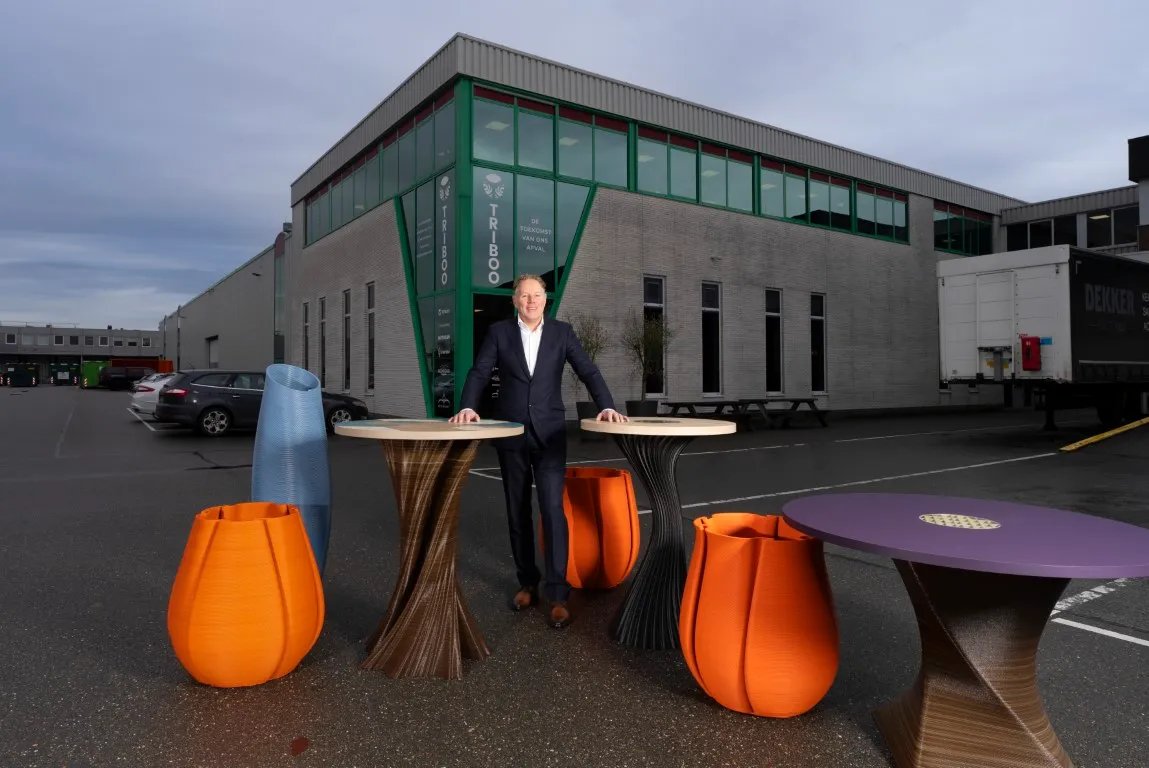
Marc van der Heijden’s influence extends beyond his own company. He is a thought leader in the Dutch circular economy sector, contributing to public initiatives such as the Green Deal Circular Procurement and advising on sustainability policy in the design and architecture sectors.
For the design community, his work offers a concrete example of how circularity can be integrated at every level—from material selection and product design to business models and supply chains. He doesn’t just talk about the future—he’s building it, piece by piece, from the plastic waste we throw away.
.webp)








.jpg)


