


#Greengridz desk and tabletops = less material = less recycling
April 9, 2026


.jpg)
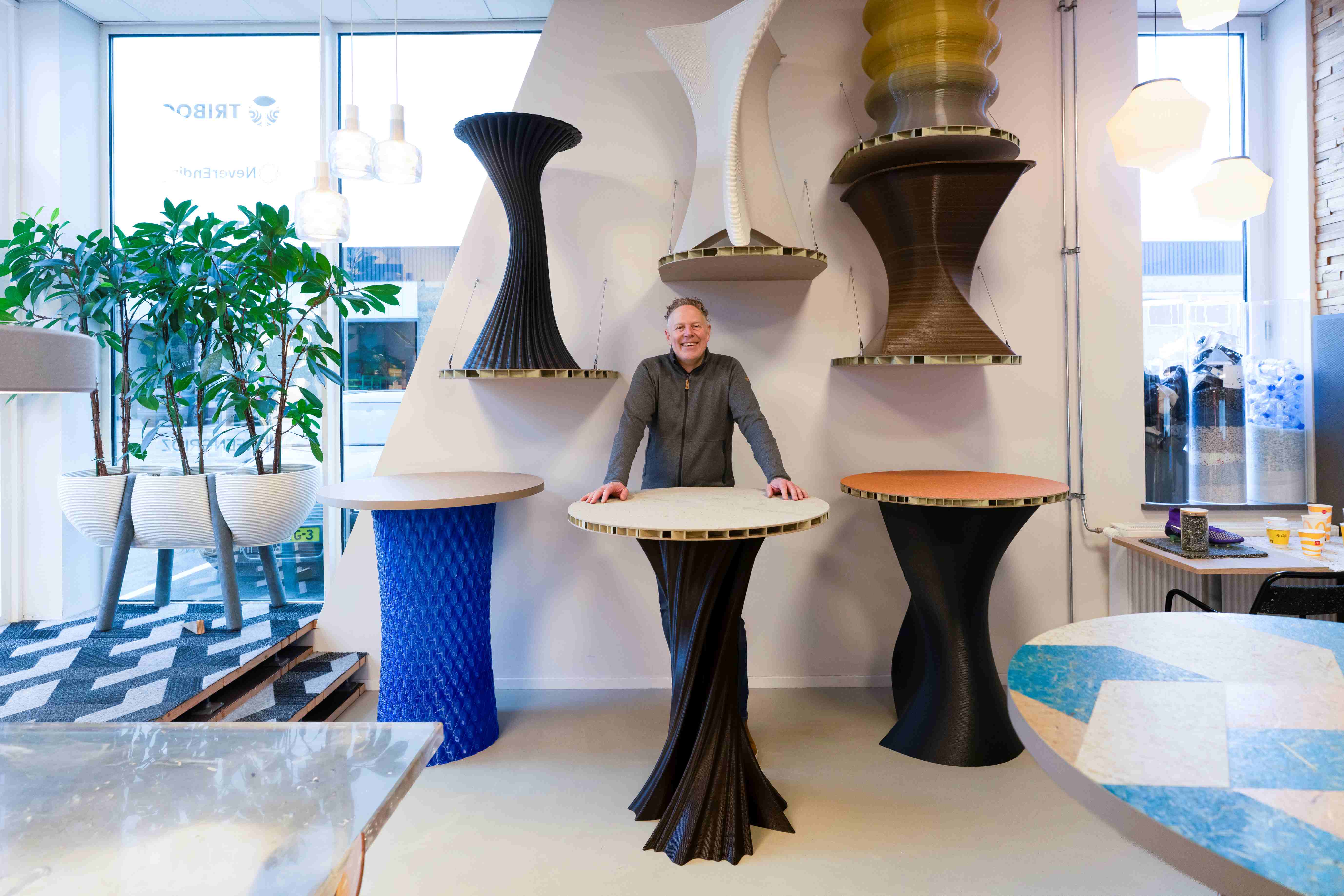
Marc van der Heijden is a leader in circular economy initiatives within the furniture and interior design industry and has been nominated as a Circular Hero. Through his company, TRIBOO, he develops furniture and office furnishings from waste streams and recycled materials—products that can, in turn, be fully reused. His mission is to stop viewing waste as a cost and instead see it as a raw material for a new generation of circular products.
That vision earned him a nomination as a Circular Hero, submitted by Ben van Elk of Dekker Zevenhuizen. According to Van Elk, Van der Heijden is one of the most passionate and innovative entrepreneurs in the Dutch circular economy sector.
.webp)
Van der Heijden started out as a logistics specialist. That background still shapes his way of thinking. “I don’t look at aesthetics first, but at material flows,” he says. “How can you shift from cost to value? How can you turn waste into raw materials that you can reuse over and over again?” Ten years ago, he founded TRIBOO with the goal of using waste streams from various industries as the basis for new materials and products. Plastics and natural fibers such as hemp, oak, and paper and cardboard waste are transformed—through revolutionary innovations and groundbreaking techniques—into eye-catching furniture, lightweight furniture panels, and complete office furnishings. A key principle is that all materials must be safe and recyclable. “Many existing supply chains contain substances that make reuse difficult. As a result, waste remains a cost center. We design products in such a way that the raw materials can be reused.”
Van Elk’s nomination is based on a long history. The two met about eight years ago at a conference on circular materials. That chance encounter led to an intensive collaboration that has now lasted for years. Shortly after the two men met, TRIBOO developed, among other things, the world’s largest 3D-printed pots for five-meter-tall trees for the Dekker Trend Centre. Other experiments followed, including a 3D-printed bathtub that went from concept to prototype within two weeks. The collaboration expanded further when TRIBOO was granted exclusive rights to the lightweight #greengridz furniture panel to bring desk and table tops and other furniture applications to market, and subsequently established itself on the Dekker Zevenhuizen site. There, both companies are working together on circular applications for the furniture and kitchen industries, among others.
A key principle behind TRIBOO’s products is that materials never permanently leave the supply chain. Van der Heijden prefers to refer to it as a raw materials bank. “And we don’t want to get rid of our materials either. That’s why we’re moving more and more toward furniture subscriptions. For the same reason, we pay five euros per kilo of furniture that’s returned. That way, we recover the raw materials we’ll need again anyway.” All TRIBOO products are designed with reuse in mind. Many parts are produced using 3D printing technology. This makes it possible to grind down materials and print them again. TRIBOO consciously chooses to use 100% recycled raw materials for this purpose.’
In addition to circular materials, the focus is on digital production and distribution. Designs are shared via the digital furniture distribution platform developed by TRIBOO and produced locally using large-scale 3D printers. This means furniture no longer needs to be physically transported around the world and arrives at its destination in a millisecond. “We don’t keep inventory and print only when we receive an order, from any country in the world. This also applies to our designs, which are printed locally in other countries. So our furniture requires no transportation.” This principle has a major impact on the furniture industry’s environmental footprint. Recent projects have shown that TRIBOO solutions can reduce CO₂ emissions by up to 60 percent compared to traditional products. “For many companies, it’s still all about ‘more.’ Selling more wood, recycling more, sorting more, and driving more. We want the opposite. We want to reduce the waste problem by using fewer materials, sorting less, and driving less, thereby reducing our environmental impact and carbon footprint.”
Although TRIBOO is growing rapidly and now has offices in countries such as Belgium and Denmark, Van der Heijden emphasizes that circular innovation can never be achieved by a single party. “No one can do this alone. You need designers, manufacturers, suppliers, and customers who are willing to change together.” It is precisely this collaboration that he sees as the key to a circular economy. “I’m committed to a transition in which rivalry gives way to collaboration.” With that mindset—and with tangible products that demonstrate that waste can be a valuable raw material—Marc van der Heijden has, with and thanks to his network, emerged as a prominent pioneer in the circular furniture industry.
.webp)





.jpg)


