
#greengridz tabletop features Dior – A New Look during an exhibition at the Kunstmuseum Den Haag
February 27, 2025


News - Story by MaterialDistrict
.jpg)



A year after MaterialDistrict profiled founder Marc van der Heijden, TRIBOO is working on the aspects of its circular furniture model that no single product can demonstrate on its own: a shared production network, soft seating designed to be taken apart, a supplier collective, and environmental metrics that can be used in a bid.
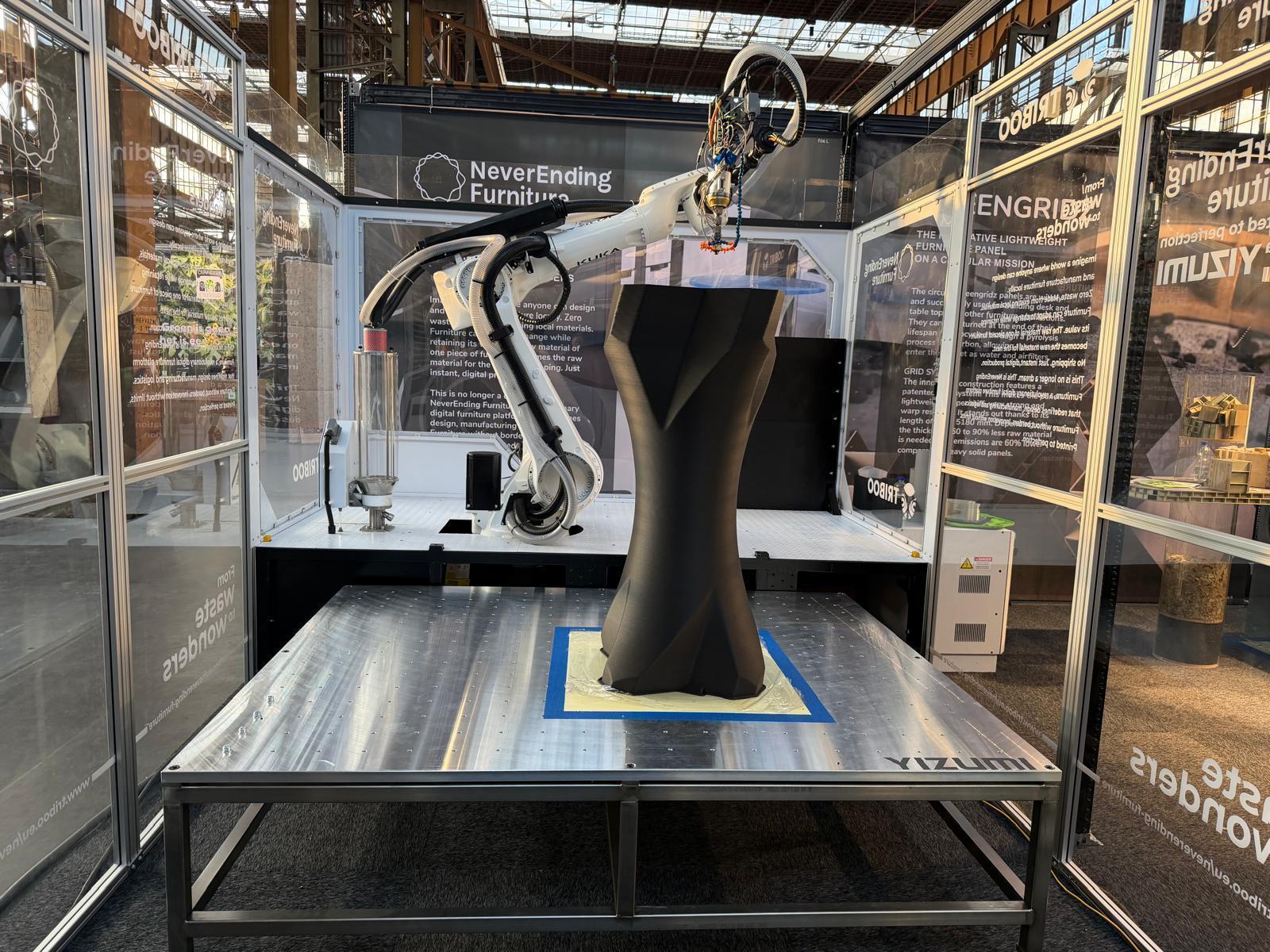
At MaterialDistrict Utrecht in March, TRIBOO did something even more revealing than simply displaying finished furniture: it put a large-scale YIZUMI robot to work on the exhibition floor and printed a piece from its NeverEnding Furniture collection live. Surrounding the printer was the rest of the company’s circular toolkit: lightweight Greengridz table tops, Nexus tables finished with SeaWood, EverUse acoustic panels clad in i-did felt, and a table and vase printed from Dutch roadside grass, developed in collaboration with Waardewenders.
MaterialDistrict’s 2025 profile of Van der Heijden covered the founding concept: local waste streams, parametric design, distributed 3D printing, and furniture offered as a service. The question one year later is not whether TRIBOO has launched more circular products—it has launched several. The question is whether the system behind them is becoming repeatable, measurable, and scalable.
The most significant change is in production. NeverEnding Furniture has always been based on the idea that a digital design can be manufactured close to where it is needed, using recycled plastics and fiber waste. Since TRIBOO and YIZUMI Germany signed a partnership agreement at Formnext in November 2025, that idea has evolved into a network plan. In June, the two companies announced that the first steps toward a standardized international network had been completed, with NeverEnding designs now printable on YIZUMI systems in the Netherlands, Germany, Belgium, and Brazil. According to TRIBOO, the print farms use the same robots, logistics, and recycled materials in every country, so a design can be transferred between them as a file, while its designer receives a fee per sale.
TRIBOO is also YIZUMI’s sales agent for these large-scale printers, so the network serves as a distribution channel for both furniture designs and the machines that produce them. The individual print farms have not been named, and no production volumes have been disclosed. An April announcement of what the companies called a world speed record for large-scale furniture printing should be interpreted in the same way: as a statement of ambition rather than an independently verified benchmark.
The principle deserves to be taken seriously nonetheless. If machines, materials, and process settings are sufficiently standardized, the same design can be produced in multiple locations without shipping bulky finished furniture across borders or maintaining inventory. It also changes what a designer delivers: not only the table, but the file and the rules by which it can be made. The open question is one that specifiers will recognize. Consistent quality across print farms favors consistent feedstock, while the environmental case rests on local, variable waste streams. How the network reconciles the two will determine just how local its local production really is.
A collaboration with the Belgian company Nozzle demonstrates a second application of the same technology. Nozzle’s UP office chair is configured based on a 3D body scan and printed locally. According to the companies, the chair is modular, so parts can be repaired, adjusted, or replaced, and printed parts made from upcycled waste can serve as feedstock for new chairs. TRIBOO offers it as a complete workstation with a height-adjustable Greengridz desk and an EverUse screen. Here, digital production is not only a path to local manufacturing but also a way to create a product for a single person without resorting to custom manufacturing.
Tables and planters are relatively simple circular products. Upholstered seating is more challenging: a conventional sofa combines foam, textiles, boards, glue, and staples that are difficult to separate at the end of its life. TRIBOO’s PUZZL collection, developed in collaboration with CircleFoam Sustainable Products, is therefore a better test of its approach than yet another table.
PUZZL combines recycled textiles (wool, polyester, and i-did felt), recycled EPS for the frame, and recycled PU foam and latex—both from CircleFoam—as well as Greengridz panels and 3D-printed parts made from recycled plastic or natural fibers. TRIBOO states that the parts are assembled without glue or staples, so each can be separated into its own material stream. Returned seats are refurbished first; at the end of their life, the materials are recovered for the next generation of PUZZL, and TRIBOO pays a raw-material fee of €0.25 per kilogram upon return. The first model, Tessella, is also available through TRIBOO’s furniture subscription service.
The compact Shard, added in August, takes the concept a step further. Rather than adding material to create a fully self-supporting object, it rests against the wall—making it ideal for pods and alcoves—while remaining unanchored and easy to move. Here, the circular design is less about substituting a recycled material and more about questioning how much structure a product actually needs. TRIBOO says an industrial supply chain is already in place to recycle every component and remake it into the same seat. What a collection launched in May cannot yet demonstrate is that loop in practice: a seat returned, taken apart, and remade.
Scaling circular interiors is also an organizational challenge. An architect rarely specifies just a tabletop; a workplace combines furniture, flooring, lighting, acoustics, and kitchens, each with its own supply chain and end-of-life process. In June, nine companies launched “Captains of the New Industry”: TRIBOO, Alvero, Dekker Zevenhuizen, Signify, i-did, CircleFoam Sustainable Products, Studio Wae, SeaWood, and Nowa Kitchen. Through any one member, a client can access the combined product range.
Several members are already featured in TRIBOO’s own products: Dekker Zevenhuizen manufactures the Greengridz panels, i-did supplies the felt for the EverUse screens, SeaWood provides the finishes for the Nexus tables, CircleFoam supplies the foam for PUZZL, and Signify provides the lighting above the printed tables. The collective partly formalizes a supply chain that already existed. That is not a weakness, since a chain that works is a better starting point than a new one. The partners say they will present their first joint projects in the coming period, and that is where its value will become apparent.
Measurement is the area that requires the most attention. Greengridz has an MRPI EPD, verified by Ecoreview and based on an LCA conducted by SGS Search in accordance with EN 15804+A2. The declaration was first issued in 2022, updated in April 2024, and is valid through 2029. It covers the entire life cycle, from raw materials to end of life, with 80 percent of the MDF assumed to be recycled into activated carbon.
The EPD estimates the climate impact of a one-meter Greengridz countertop—600 millimeters wide and 38 millimeters thick—at 9.3 kilograms of CO₂ equivalent over its lifetime: about 15.5 kilograms per square meter. TRIBOO compares this with particleboard and plywood tops of the same size, across the same life-cycle stages: 28.5 and 39.5 kilograms per square metre. This places Greengridz about 45 percent below particleboard and 60 percent below plywood. On the Environmental Cost Indicator (MKI), calculated using the current Dutch method, the figures are €3.85 per square meter for Greengridz, compared to €6.07 for particleboard and €11.68 for plywood.
The CO₂ figure for Greengridz comes from its EPD. The figures for particleboard and plywood come from separate LCAs conducted by the same consulting firm, which were verified by the same verifier but not published as EPDs. The EPD lists the MKI only under the previous calculation method; the figure for Greengridz calculated using the current method was provided by TRIBOO.
Taken individually, these are incremental steps: a digital furniture platform with an international printing network in its first phase, a chair, a seating system, a collective, a number. Together, they show where the circular furniture debate is headed. Proving that an attractive object can be made from waste is no longer the hard part. The hard part is the production network, logistics, partnerships, data, and return loops that allow the same principle to be applied repeatedly.
The largest test to date is at Movares, where TRIBOO is furnishing six offices under a ten-year subscription: 1,000 workstations plus other furniture, phone booths, and meeting pods. The next tests will focus on practical aspects: whether print farms in four countries can produce the same product using different feedstock, how returned PUZZL materials perform after their first cycle, and whether an architect can source a completely circular interior through the new collective.
That is what makes the printer at MaterialDistrict in March a useful starting point. On the exhibition floor, it was quite a sight. Six months later, the more interesting story is the system being built around it.









.jpg)


